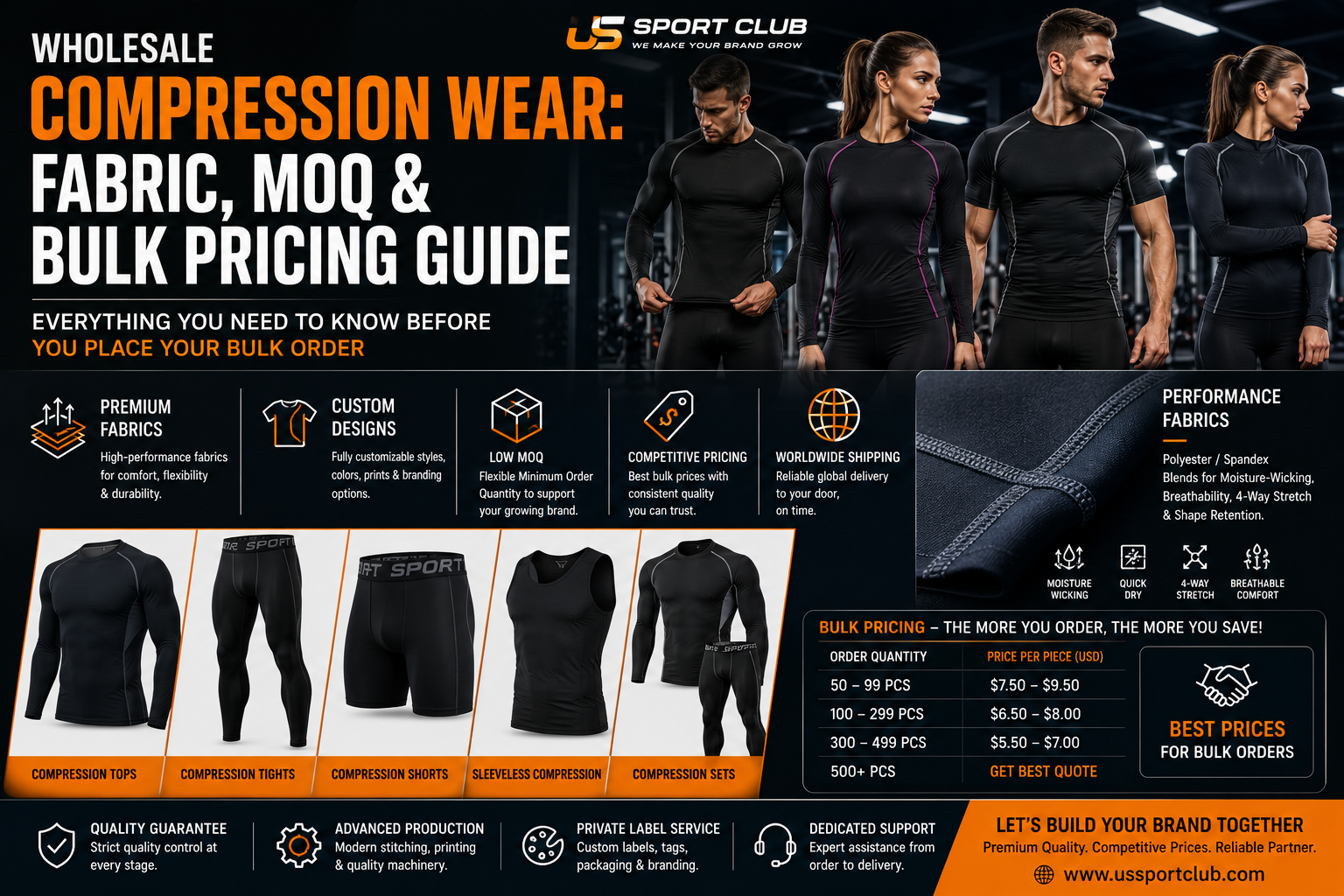
What buyers actually need to know before placing a bulk compression wear order — from fabric composition to realistic pricing expectations.
Introduction
Compression wear has moved well beyond a niche performance product — it's now a staple across sports teams, gyms, fitness brands, and private-label athleisure lines. But sourcing it wholesale is a different challenge than sourcing standard jerseys or t-shirts. The fabric technology is more specialized, the fit tolerances are tighter, and pricing depends on variables most buyers don't ask about until it's too late.
This guide covers exactly what matters when placing a wholesale compression wear order: the fabric science behind it, realistic MOQ expectations, and how bulk pricing is actually structured — so you can source with confidence instead of guesswork.
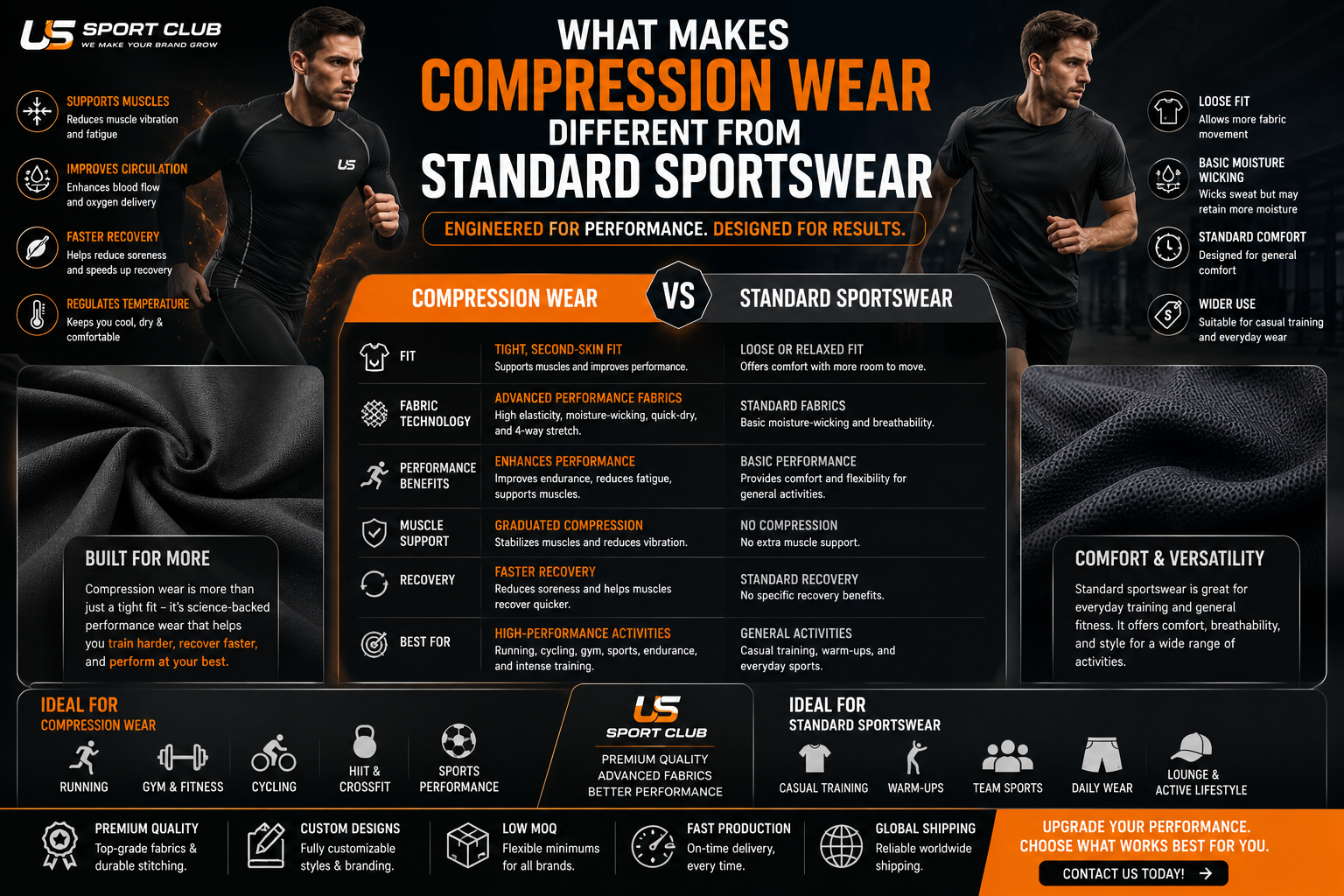
What Makes Compression Wear Different From Standard Sportswear
Compression garments are engineered to apply graduated pressure to muscles, which means the fabric itself has to behave differently than a standard jersey:
- High elastane/spandex content (typically 15-25%) blended with polyester or nylon for stretch and recovery
- Four-way stretch construction — fabric needs to stretch both horizontally and vertically while returning to shape
- Tighter knit density than standard sportswear, which increases both fabric cost and production precision
- Flatlock or seamless stitching to prevent chafing under tight, second-skin fits
Because of this, compression wear can't be manufactured on the same production line or with the same fabric sourcing as standard loose-fit jerseys — which directly affects both MOQ and pricing.
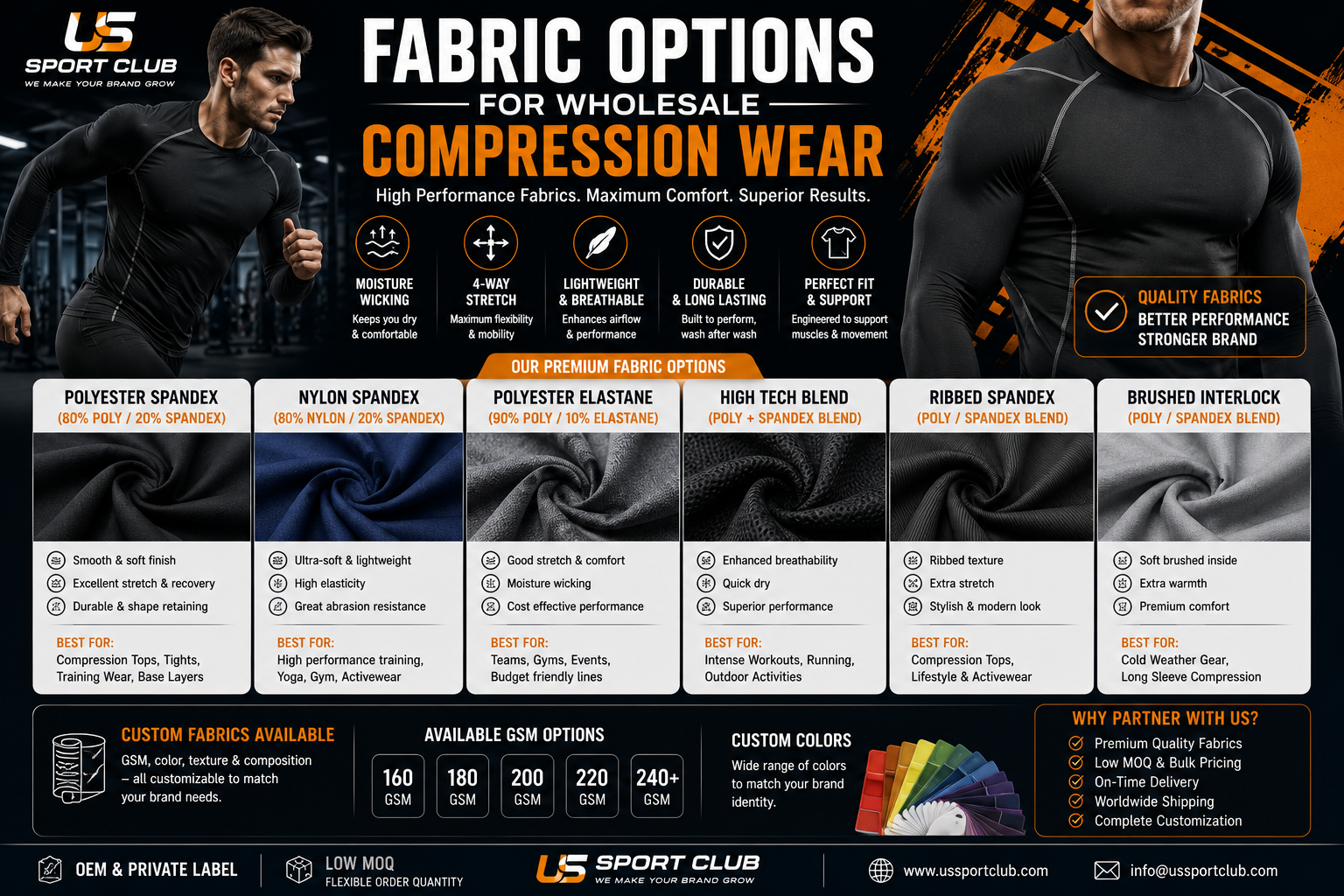
Fabric Options for Wholesale Compression Wear
| Fabric Blend | Compression Level | Best For |
|---|---|---|
| Polyester-Spandex (80/20 or 85/15) | Moderate | General athletic wear, training gear |
| Nylon-Spandex (78/22) | Higher, smoother finish | Premium compression lines, base layers |
| Recycled Polyester-Spandex Blends | Moderate | Sustainability-focused private label brands |
| Mesh-Paneled Compression | Targeted (zonal) | High-intensity sports needing extra ventilation |
Key sourcing tip: Always ask for the exact elastane percentage, not just "stretch fabric." Anything under 10% elastane typically won't deliver true compression benefits — it'll just feel like a snug regular garment, which matters if you're marketing the product specifically as compression wear.
Understanding MOQ (Minimum Order Quantity) for Compression Wear
MOQs for compression wear tend to run higher than standard jerseys, for a few specific reasons:
- Specialized fabric rolls — compression fabric is often ordered in larger fabric roll minimums from mills, which gets passed down as a garment MOQ
- Flatlock stitching setup — specialized machinery and thread setup isn't cost-effective for very small runs
- Color/print matching — dye lots for stretch fabric need to be consistent across the full order to avoid visible shade variation
Typical MOQ ranges you'll encounter:
- Per style, per color: Often 50-100 units as a starting point with most manufacturers
- Single-piece or sample orders: Possible with manufacturers who explicitly support small-batch or single-piece customization, though per-unit cost will be notably higher
- Private label starter runs: Some manufacturers offer reduced MOQs specifically for new brands testing a design before committing to a full production run
If a supplier claims no MOQ at all on compression wear, ask specifically how — it usually means either standard blanks with only printing customization (lower barrier) or a small-batch production model built for exactly that flexibility.
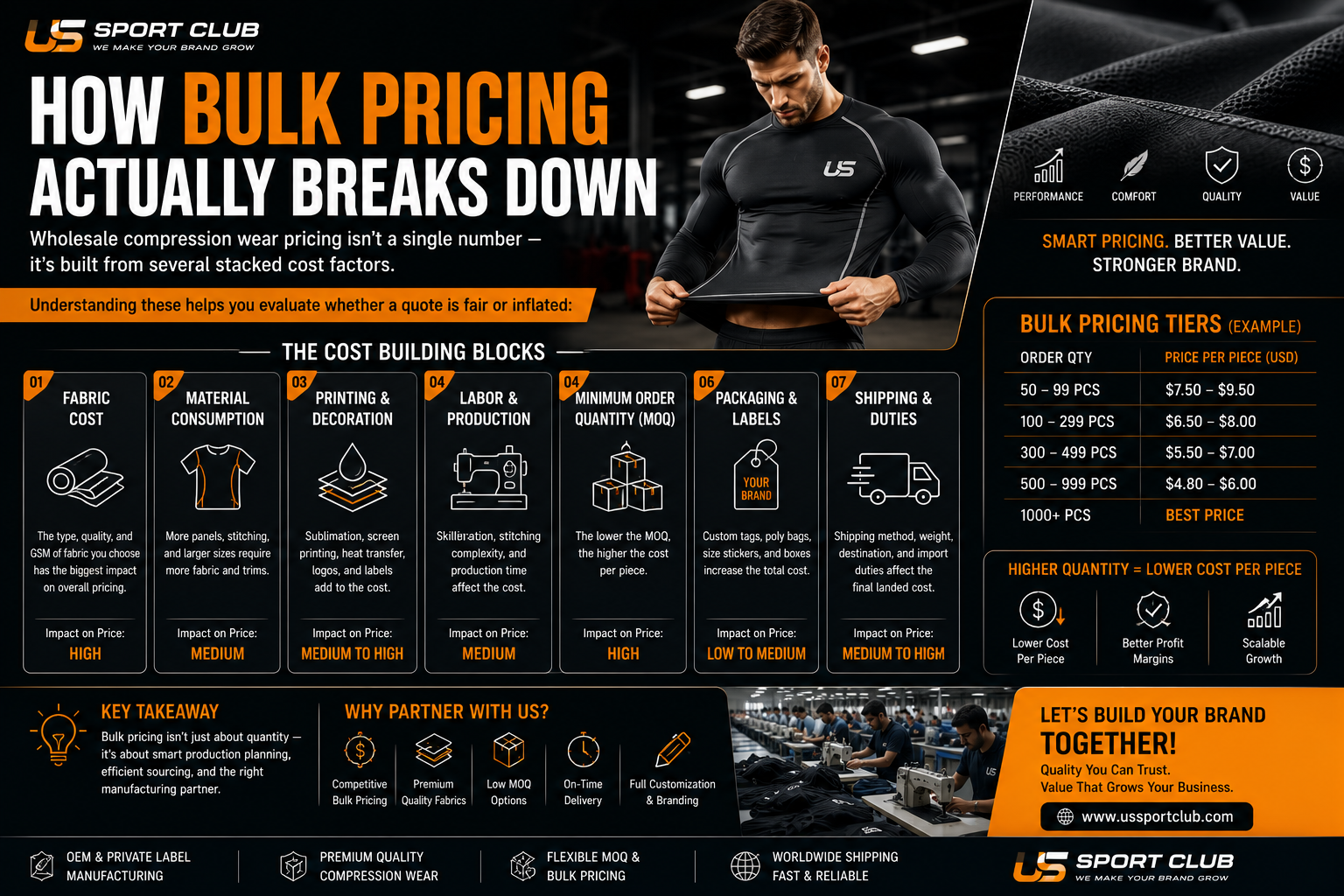
How Bulk Pricing Actually Breaks Down
Wholesale compression wear pricing isn't a single number — it's built from several stacked cost factors. Understanding these helps you evaluate whether a quote is fair or inflated:
1. Fabric Cost
Higher elastane content and denser knit construction cost more per meter than standard polyester. Nylon-spandex blends typically cost more than polyester-spandex blends.
2. Order Volume
As with most manufacturing, per-unit price drops as volume increases — but the drop-off curve is steeper for compression wear between small and mid-size orders due to fixed setup costs (cutting, stitching calibration, dye lot minimums).
3. Customization Complexity
- Solid color with basic logo: lowest cost
- Sublimated all-over print: moderate increase
- Multi-panel mesh construction with zonal compression: highest cost, due to more complex cutting and stitching
4. Stitching Method
Flatlock stitching (standard for compression wear to prevent chafing) costs more per unit than standard overlock stitching used on looser-fit garments.
5. Packaging & Labeling
Private label orders requiring custom neck labels, hang tags, and branded packaging add a per-unit cost that should be quoted separately from the garment cost itself.
Questions to Ask Before Placing a Wholesale Compression Wear Order
- What is the exact fabric composition (fiber percentages), not just a general description?
- What is the MOQ per style and per color — and does it change for reorders?
- Does the quoted price include printing/customization, or is that a separate line item?
- What stitching method is used, and is flatlock construction standard or an upsell?
- Can a sample be approved before the full production run is confirmed?
- Is there a reduced MOQ option for private label brands testing a new line?
Frequently Asked Questions
What's a realistic MOQ for wholesale compression wear? Most manufacturers set MOQs around 50-100 units per style/color, though some offer smaller batch options or single-piece customization at a higher per-unit cost.
Why is compression wear more expensive per unit than standard jerseys? Compression wear uses higher-cost stretch fabric blends, requires flatlock stitching to prevent chafing, and demands tighter production precision — all of which add cost compared to standard loose-fit garments.
Can I start a private label compression wear line with a small order? Yes, some manufacturers offer reduced MOQs specifically for private label brands testing new designs before scaling into full bulk production.
Does fabric percentage really affect compression performance? Yes — elastane content below roughly 10% generally won't provide true graduated compression, so it's worth confirming exact fiber percentages rather than relying on marketing terms like "stretch fabric."
Final Thoughts
Wholesale compression wear sourcing rewards buyers who ask the right technical questions upfront — fabric composition, stitching method, and true MOQ flexibility all affect both product quality and final pricing far more than a quoted number alone suggests. Getting these details right before production starts is what separates a compression line that performs and sells well from one that ends up as a costly reprint.
Looking to source wholesale compression wear or start a private label compression line? [Get in touch] to discuss fabric options, MOQ, and bulk pricing — from sample orders to full-scale production.
