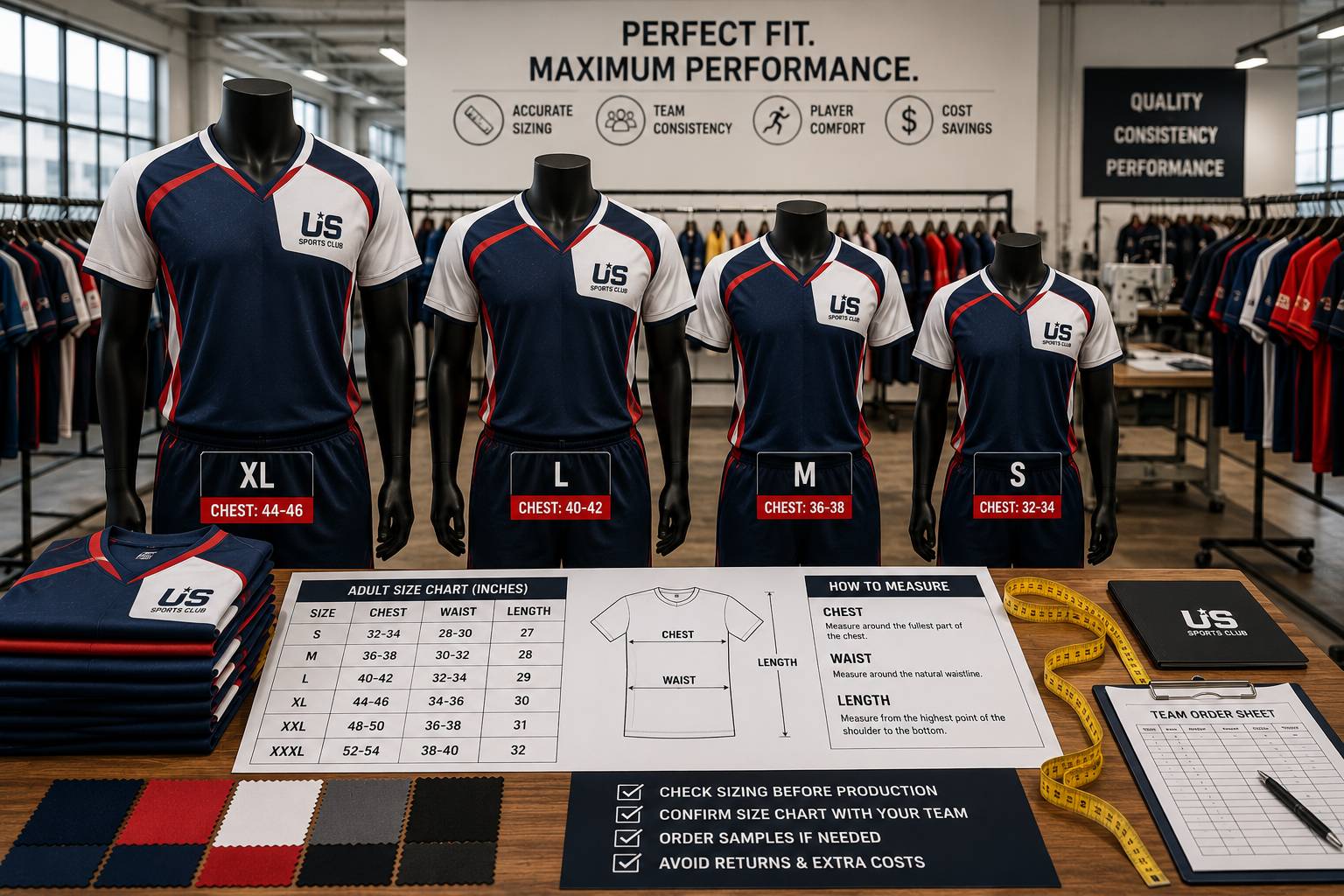
Sizing errors on a 100+ piece uniform order are expensive to fix after production. Here is how clubs and brands should collect and confirm sizing before placing a bulk custom uniform order.
A sizing mistake on a bulk uniform order is one of the most expensive errors a club or brand can make — by the time a shipment of 100+ jerseys arrives and half the roster can't get the right fit, a reorder means paying for production twice and missing the season entirely. Getting sizing right before production starts is far cheaper than fixing it after.
1. Never Rely on Standard Retail Size Charts Alone
Athletic cut garments (soccer, basketball, rugby) typically run differently than everyday retail clothing — often more fitted through the torso with room through the shoulders. Always request your manufacturer's actual measurement chart in centimeters (chest, length, sleeve) rather than assuming "Medium" means the same thing across brands or sports.
2. Collect Individual Measurements for Teams, Not Just Size Labels
For team orders, the safest approach is collecting chest and height measurements per player rather than self-reported shirt sizes — self-reported sizes are notoriously unreliable, especially for youth teams and across different sports where fit expectations vary (compression-fit rugby jerseys vs. looser basketball jerseys).
3. Always Order a Physical Size Sample Set Before Bulk Production
Request one physical sample in each size (or at minimum S, M, L, XL) before confirming your full production run. A sample set lets your team physically try garments on and confirm fit, rather than trusting a size chart on paper — this single step prevents the majority of costly bulk-order sizing disputes.
4. Account for Fabric Behavior After Washing
Some fabrics (especially cotton blends) shrink slightly after the first few washes, while performance polyester blends generally hold dimensions well. Ask your manufacturer whether their fabric is pre-shrunk or compacted, and factor a small tolerance into fit-critical garments if it isn't.
5. Build in a Buffer for Size Distribution
Rather than ordering the exact headcount per size, add a small buffer (5–10%) split across your most common sizes to cover roster changes, growth (for youth teams), and replacement units — reordering a handful of pieces later at bulk MOQ is far more expensive per-unit than adding a few extra at initial production.
6. What to Send Your Manufacturer
- A size breakdown by quantity per size (e.g. "S: 8, M: 22, L: 15, XL: 5")
- Confirmation of which sport/fit type each size chart applies to
- Any players requiring custom/out-of-standard-range sizing
US SPORT CLUB sends a physical size sample set before every bulk team uniform order — across soccer, baseball, basketball, cricket, rugby, and volleyball kits — so your team confirms fit before we cut a single roll of fabric for the full production run.
